
A report by Martin van der Ven (October 2025)
 Nederlandstalige versie –
  Deutschsprachige Version
By the summer of 1964, offshore radio stations were no longer a novelty in Europe’s coastal waters – they were springing up like mushrooms. Radio Veronica was broadcasting from the Borkumriff to Dutch listeners, while Radio Caroline North, operating from the MV Caroline, and Radio Caroline South from the MV Mi Amigo were establishing their legendary reputation as the most famous floating radio stations in the world.
Radio Syd transmitted from the MS Cheeta for a Swedish audience, while Radio Sutch on Shivering Sands Fort and Radio Invicta on Red Sands Fort served smaller English audiences with their comparatively modest transmission power. On the newly built steel REM Island, RTV Noordzee was even providing Dutch audiences with both radio and television programmes – a small revolution at sea.
The Rumour Mill in Overdrive
Accordingly, the rumour mill was working overtime with talk of new stations and new target areas. Newspapers and magazines reported regularly – but it was hard to distinguish between serious journalism and pure sailor’s yarn.
At the end of August 1964, speculation was rife in the Netherlands: the deep-sea trawler Norderney, which was then being converted into a new broadcasting ship for Radio Veronica at the Zaanlandse Scheepsbouw Maatschappij (ZSM) in Zaandam, was said to be destined instead as a German radio ship. At least four newspapers reported along those lines – a misunderstanding that conveniently served as a welcome diversion for the Veronica organisation.
Then, on 31 August and 1 September, came the next headline: numerous Dutch newspapers, citing agency reports, claimed that a certain Manfred Weissleder, a bar owner from Hamburg, was in fact planning a new offshore station aimed at German listeners.
The Flamboyant Manfred Weissleder

His technical skill quickly brought him advancement: he began by installing neon lights in the St Pauli bar Tabu, and before long was working on larger projects. But his name also began to appear in court files. In 1960, the 6th Criminal Chamber of the Hamburg Regional Court, as part of a crackdown on producers and exhibitors of pornographic films, ordered the destruction of 30 colour and 3D films that Weissleder had made featuring so-called “strip artists”. The verdict was later overturned, but Weissleder remained on the authorities’ radar.
From Electrician to Music Magnate
By 1962, the 1.9-metre-tall, close-cropped bachelor already owned several establishments in Hamburg’s Paradieshof, including the Erotic Nightclub at Große Freiheit 39 – the centre of a small, semi-legal empire of up to 13 venues. When the building authorities demanded an emergency exit for the Paradieshof, Weissleder simply bought the adjacent Stern Cinema – initially as a way to provide an escape route, then as a business opportunity.

Where the Beatles Were Born
The Star-Club quickly developed into one of the most important music venues in the world – on a par with Liverpool’s Cavern Club. Seven nights a week, up to eight bands played until the early hours of the morning. Admission cost between two and five Deutschmarks, and the hall could accommodate around 1,000 people. About 70,000 visitors came each month – roughly one million per year.
The Cadillac driver and amateur diver Weissleder demonstrated a keen instinct for talent and trends. His word was considered reliable – even among musicians and managers in Britain and the United States. The club’s logo, a five-pointed star in sweeping neon script, became an international trademark.
The Beatles played on the opening night. By the end of 1962, the “Fab Four” had appeared on the Star-Club stage 79 times, launching their world career from Hamburg. Weissleder had posters printed bearing a bold slogan: “The misery is over! The time of village music is past!”
Over the following years, the biggest names in rock ’n’ roll passed through the doors of the Star-Club: Brenda Lee, Ray Charles, Jimi Hendrix, The Searchers, The Animals, Tony Sheridan, Screaming Lord Sutch, Bill Haley, Chuck Berry, Jerry Lee Lewis, Little Richard, The Rattles, Cream, Fats Domino and Manfred Mann – they all played on St Pauli.

Between Fame and Friction
But success also brought problems. The Star-Club – “the world where the Beatles were born”, as Weissleder called it – soon attracted the attention of the authorities. Hamburg magistrate Kurt Falck, head of the Hamburg-Mitte Economic and Public Order Officeand and also known as “the iron broom of St Pauli”, accused the club and its bouncers of excessive violence. In his reports, Falck wrote that guests had been “beaten up”, “kicked”, or “forcibly dragged out of the club”.
Police from the Davidswache station had to intervene almost 90 times at the Star-Club in 1963 alone. By then, Weissleder had become a thorn in the side of law enforcement and was subjected to ever stricter regulations, ID checks and bureaucratic harassment. Yet his name remained inseparable from Hamburg’s wild, emerging music scene – and from an era in which an electrician, a visionary and an entrepreneur together helped to shape music history.
Licence Revoked, Closure — and New Ambitions
When the situation escalated, the police eventually revoked Weissleder’s operating licence and the nightclub was closed – albeit only for a few days. The club owner reacted pragmatically: he dismissed a dozen waiters, transferred the licence to Hans Bunkenburg, who was managing director of Weissleder’s Star-Club GmbH, and focused his efforts on his other establishments.

By now 36 years old, Weissleder – known across St Pauli as the “King of the Reeperbahn” and purveyor of beer, bare skin and rock ’n’ roll – refused to be discouraged. He had Star-Club commemorative medals struck, which fans discreetly sold on for 15 marks apiece. He also registered “Star-Club” as a legally protected trademark and began leasing it for 1,000 marks a month to publicans in Flensburg, Kiel, Cologne and Berlin. His plan was to build a network of Star-Clubs across the country, reaching as far south as Munich.

He also launched his own Star-Club record label and announced plans to sell the previously free Star-Club News magazine at kiosks across West Germany from 1 October, priced at around 50 pfennigs, featuring news from the music scene written by Weissleder himself.
His ambition was clear: to make Hamburg the paradise for Germany’s twist and rock ’n’ roll bands – a “Mecca of hot music”. A key part of this grand vision, however, was an offshore radio station broadcasting from international waters.
Big Words and Conflicting Reports
The announcement of the planned radio station caused a worldwide stir. Yet the coverage in newspapers and trade journals — from Bild and Der Spiegel to Billboard and numerous Dutch papers — was often contradictory and riddled with historical inaccuracies. For most reporters, only one thing seemed certain: Weissleder intended to anchor his radio ship beyond the three-mile limit at the mouth of the River Elbe. One Dutch correspondent, however, placed the project in the Baltic Sea.


Weissleder explained that an obsolete Norwegian bulk carrier of around 3,000 gross registered tonnes had been loaded with scrap ballast in Northern Ireland “so that it won’t capsize.” The ship, he added, was to be equipped with an antenna more than 30 metres high.
A 150 kW medium-wave transmitter from Japan was reportedly to provide the signal. With the help of 15 Norwegian seamen, two high-frequency technicians, and two disc jockeys, Weissleder planned to offer German and Danish listeners a 19-hour nonstop programme of music and advertising.
With a theoretical range of nearly 400 kilometres, “Star Radio” — according to Weissleder — would cover the entire broadcast area of NDR and Radio Bremen, as well as large parts of the territories served by WDR and Hessischer Rundfunk. The planned transmitter, he claimed, would be 50 kilowatts stronger than NDR’s major Hamburg station.
Ever the optimist, Weissleder predicted that one in five of the estimated six million listeners between Jutland and Kassel, from the Ruhr region to Berlin, would soon switch from their domestic stations to his new offshore broadcaster.
Radio Bremen promptly announced that it would use “all technical and legal means” to silence the new competitor operating in international waters.
In the press, the project appeared under a variety of names: Star Radio, Star-Club Radio, Radio Star-Club, Star-Club Station, and Star Radio 1.
Director, Programme Chief, and Entrepreneur

There was much speculation about the station’s financiers. Allegedly, a Swiss and a British backer were behind the venture, though their identities remained undisclosed. Weissleder claimed he “knew their names” but had “never met them.” He further asserted that one of them was “a man of considerable means who also finances the four English stations.”
Weissleder announced that he would fly to London on 2 September to hold negotiations. The Star Radio headquarters in Dean Street would, he said, be managed by Henri Henroid a Swiss-born show-business figure who had emigrated to England and was formerly the manager of Mario Lanza.
Weissleder was equally confident on the commercial side. “A whole number of companies and advertising agencies — including two major firms from the oil and record industries — have already approached us,” he declared. In London, the margarine company Unilever was said to have expressed interest in booking commercial airtime.
Legal Hurdles and the Authorities’ Response
When exactly “Star Radio” would take up its broadcasting position off the Elbe estuary, Weissleder said, depended largely on the speed of his legal team, which was “examining the laws of four countries — Norway, England, Denmark and the Federal Republic — to make sure nothing can happen to us.”

The West German government in Bonn initially reacted with calm. Ministerial Councillor Dr Weling from the Federal Ministry of Posts remarked laconically:
“We don’t have a gunboat to shoot them down. And if the radio station is outside national German waters, what exactly are we supposed to do?”
His comment left open the question of how effective any legal measures against an offshore broadcaster anchored beyond the three-mile limit could really be.
A Dream at Sea – and Its Slow Demise
The launch date, originally announced with great optimism, was pushed further and further back as the months went by. In the first reports at the end of August 1964, it was still claimed that the radio ship would anchor before the onset of the November storms in the treacherous waters off the mouth of the River Elbe.
Weissleder explained at the time that the schedule also depended on the pace of a team of lawyers who were “examining the laws of four countries (Norway, England, Denmark, and the Federal Republic of Germany) to make sure nothing can happen to us.”
On 15 September, reports suggested that broadcasts could begin “within seven weeks.” Only a few days later, the date was postponed again – now mid-October was mentioned. It was not until 20 November that the Dutch newspaper De Telegraaf reported that the radio ship would “leave the Irish port within the next few days,” and that broadcasting could begin as early as 1 December.

Shortly before Christmas 1964, Weissleder remained defiant in London. The action taken by the Dutch authorities against the radio and television station on the REM Island, he declared, did not impress him “in the slightest.” He still intended to begin broadcasting the following year.
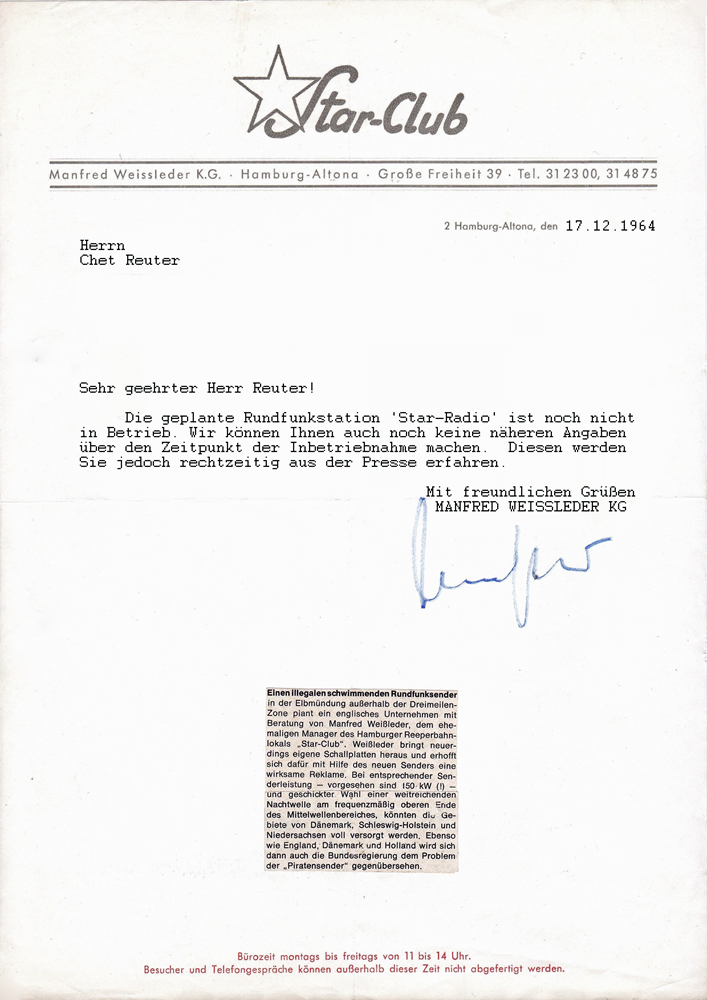
Reality, however, soon caught up with him. On 6 February 1965, the American magazine Billboard published a brief but decisive report: Manfred Weissleder had abandoned his plans. Scandinavian members of his radio team could face prosecution by their own authorities, making the realisation of the project impossible.
A Project That Vanished into Thin Air
And so it ended as perhaps it had to: an ambitious, hope-filled venture dissolved quite literally into sound and smoke. To this day, no one knows for certain whether the alleged Norwegian radio ship, supposedly refitted in Ireland, ever really existed – or whether the much-discussed 150-kilowatt medium-wave transmitter was ever more than a myth.

For Weissleder, the failure was a heavy blow. His reputation undoubtedly suffered from the collapse of the radio project. His Star-Club was also in decline by the mid-1960s: the brilliance of the early years had faded, and frustration among musicians, staff, and audiences was growing. The stars stopped coming, the fans drifted away disappointed.
In September 1967, Weissleder finally drew the line – the man once hailed as the “German Brian Epstein” ended his involvement with the Star-Club.
On the night of 27 February 1980, Manfred Weissleder died of heart failure at the age of just 52. A life marked by energy, ingenuity and unrelenting entrepreneurial drive – and by a bold vision, a radio station on the high seas, that never came to be.
Light into Darkness
It took more than five decades before anything more became known about the background of this project. It was not until 2019 that Laurence Myers, an Englishman born in 1936 and a producer and manager of renowned pop groups, shed light into the darkness. In his memoirs, he describes for the first time details of a little-known chapter from the early days of pop radio.
Myers had his breakthrough in the music industry in 1964, when, on behalf of the legendary producer Mickie Most (1938–2003), he worked as an accountant for The Animals and Herman’s Hermits. In his book Hunky Dory (Who knew?), he writes that both he and Most were convinced they could be just as successful with an offshore radio station for German listeners as Radio Caroline had been in Britain.

According to Myers, the idea for the project originated either from Hamburg’s Star-Club founder Manfred Weissleder or from the enterprising Henri Henroid (1936–1998). Henroid had first worked as a road manager of Gene Vincent and Little Richard for the British music manager Don Arden. Many of the acts that Arden placed at the Star-Club were managed directly by Henroid—until he eventually broke away from his boss and began arranging bookings for the Star-Club jointly with Weissleder. He engaged major American pop and rock stars and many Liverpool bands for the club. Around the mid-1960s, he also managed Emperor Rosko, the colourful Radio Caroline DJ.
Myers recalls: Weissleder—“a clever, slippery character”—had explained to him and Most that he could “easily raise the cash” for the station. A German rum importer was interested. He owned a ship moored in Flensburg, which was currently being used to house Turkish workers who had been recruited. In addition, the electronics company Telefunken had offered to supply and install the complete transmission system—in exchange for preferential advertising slots.
Shortly afterwards, Myers and Henroid flew to Hamburg to inspect the ship. “I stamped my foot twice on the wood and declared the ship provisionally approved,” Myers writes drily.
The next day, Weissleder appeared on German television. Using attractive graphics, he showed how little white radio waves beamed out from the ship’s mast—a charming demonstration of the planned broadcast range. Back at the office, the telephone rang non-stop: potential advertisers were eager to sign up.
The mood was euphoric. “In just three days we had a ship, the equipment, and plenty of interested parties,” says Myers. Mickie Most then offered him a 25 per cent stake in his music companies, and the same to Henroid. He himself would keep the remaining 50 per cent—after all, he was to oversee the radio programming. Myers’ conclusion: “We would follow the example of Radio Luxembourg and, in return for special advertising promotions, acquire the publishing rights to songs. We would become very rich.”
But before the technical inspection could even begin, the project collapsed. Weissleder called to say that the German government had firmly rejected the plan. The rum importer and Telefunken had consequently withdrawn. Weissleder himself wished to pull out as well, owing to his “particular business interests.”
Myers briefly considered continuing the project on his own—but then abandoned the idea.
