
The offshore radio project that never made it to air
The sinking of the Mi Amigo on 20 March 1980 marked a dramatic low point in the long and turbulent history of Radio Caroline. Yet, as so often in offshore radio history, the loss of one ship immediately sparked new ambitions. Within weeks, a small group of people associated with Caroline began planning a fresh station of their own. Paul Graham, Stuart Russel (Nigel Harris), Richard Thompson (Bob Lawrence) and Peter Moore are said to have been directly or indirectly involved in the planning. The project was given a suitably optimistic name: Radio Phoenix.
Early ambitions
By May and June 1980, several vessels were inspected as potential radio ships, but all proved too expensive. In August, a breakaway group was formed by Roger Mathews and Stuart Russell. Mathews managed to raise around £10,000, intended to cover the purchase of a ship and a transmitter.
Crucially, Mathews entered discussions with Freddie Bolland, a well-known Dutch businessman with experience in offshore broadcasting. An agreement was reached under which Bolland would supply a Dutch daytime service, broadcasting between 07.00 and 16.30 under the name Radio Monique. A number of former Caroline and Mi Amigo DJs were recruited, including Marc Jacobs and Herman de Graaf.
Studios were to be built in the Netherlands for programme production, while some output would be broadcast live from the ship. Mathews assured Bolland that a suitable vessel and transmitter were already secured — a claim that later proved to be untrue. Nevertheless, Bolland agreed to advance £5,000 as prepaid rental for the use of the transmitter.
The Birchlea gamble
In September 1980, Mathews toured several British ports in search of a ship. Eventually he found the Birchlea, a 350-ton former trawler, lying in Aberdeen, and purchased her for £5,000. Although structurally sound, the ship was in poor mechanical condition: the main engines were not operational, most generators were missing, and much of the electrical and mechanical equipment had been removed.
That same month, a transmitter was acquired, believed to deliver 5,000 watts. Later testing revealed its true output to be only 2,000 watts.
Mounting delays and financial strain
By October, the Dutch consortium was told that broadcasting would begin that month, though internally it was clear that February 1981 was the earliest realistic target. Two 60-foot masts were purchased, along with a 20,000 VA generator to provide basic power for lighting and heating aboard Birchlea. A second generator, required to power the transmitter, was still only a plan.
In November, Dutch confidence began to evaporate. With no signal on air, they were told that technical problems had delayed progress and that transmission might begin by Christmas. The response from the Netherlands was blunt: they would not wait that long.
Money was now critically short. Unable to approach the Dutch investors again, Mathews turned to Paul Graham, who was himself planning an offshore operation from one of the Thames forts. After visiting Aberdeen, Paul agreed to divert his available funds into the Radio Phoenix project.
A change of ship: Cedarlea
In December 1980, a marine diesel engineer spent two days inspecting Birchlea’s engines. His verdict was decisive: several key components were missing, repairs would cost several thousand pounds, and towing the vessel to an offshore location would add further expense. Radio Phoenix appeared finished.
Moored just a few yards away, however, lay Birchlea’s sister ship, Cedarlea. Her owner was in severe financial difficulty and keen to sell quickly. An agreement was reached under which Cedarlea would be rented, with payment to follow once broadcasting began.
Unlike Birchlea, Cedarlea appeared to be in better mechanical condition. The equipment also included two generators that could theoretically supply enough power for a 100-kilowatt transmitter. With Christmas approaching, no immediate departure was possible, and the project paused for the holiday period.
The final voyage
Terry Purvis takes up the story: “There was nothing perfect about the vessel at all, quite the reverse in fact. I was asked to skipper the Cedarlea from Aberdeen down to Kent early in January 1981. Met by at the quayside by Peter Moore the first thing that surprised me was seeing some welding being done to fix a small hole in the bow. After a good look over the vessel in my opinion it was a floating wreck, in very poor structural and dubious mechanical condition and despite repeated assurances I seriously doubted she could make the voyage. None of the navigational equipment was working properly either. With the support of Peter I refused to take it to sea and a heated discussion with the others on board followed. Peter and I travelled back to London by train the next day. They quickly found somebody willing to take the risk and what happened next was inevitable.“
At 12.00 on 19 January, Cedarlea left Aberdeen, bound south for Kent, where the transmitter and aerial system were to be loaded and assembled at sea.
Meanwhile, a studio was under construction in Leicester, intended for pre-recorded programming.
Sailing down the east coast, Cedarlea encountered severe weather 20 miles off the Suffolk coast. Dense fog developed, and the ship’s radar failed. With the hazardous sandbanks of the Thames Estuary ahead, the captain made the prudent decision to divert to Ipswich.
At 21.00 on 21 January, Cedarlea arrived safely. Shortly afterwards, internal disputes among the backers escalated. Crew wages failed to materialise, and the crew abandoned the vessel and returned to Scotland. Planned work on the anchoring system was never carried out.
Collapse and disappearance
By February 1981, the Dutch consortium learned that Cedarlea was stranded in Ipswich. Furious, they demanded the return of their money. Roger Mathews disappeared to Ireland, attempting to avoid both Dutch and British creditors.
Arguments continued on both sides of the North Sea. Paul Graham made a final attempt to salvage the project by meeting Freddie Bolland, but negotiations failed. By the end of February, Radio Phoenix was abandoned, with losses estimated at £20,000 or more.
Cedarlea remained laid up in Ipswich for some time, during which rumours circulated that Radio Caroline might acquire her.
An unexpected epilogue
In September 1981, the story took an unexpected turn. The environmental organisation Greenpeace purchased Cedarlea for just £2,500 from her financially distressed owner. The ship would soon embark on a completely different career — one that would give her a lasting place in maritime and broadcasting history, albeit far removed from the offshore radio dream that had briefly been known as Radio Phoenix.
Martin van der Ven, January 2026
Source: The Encyclopedia of Offshore Broadcasting
| ShipSpotting.com |
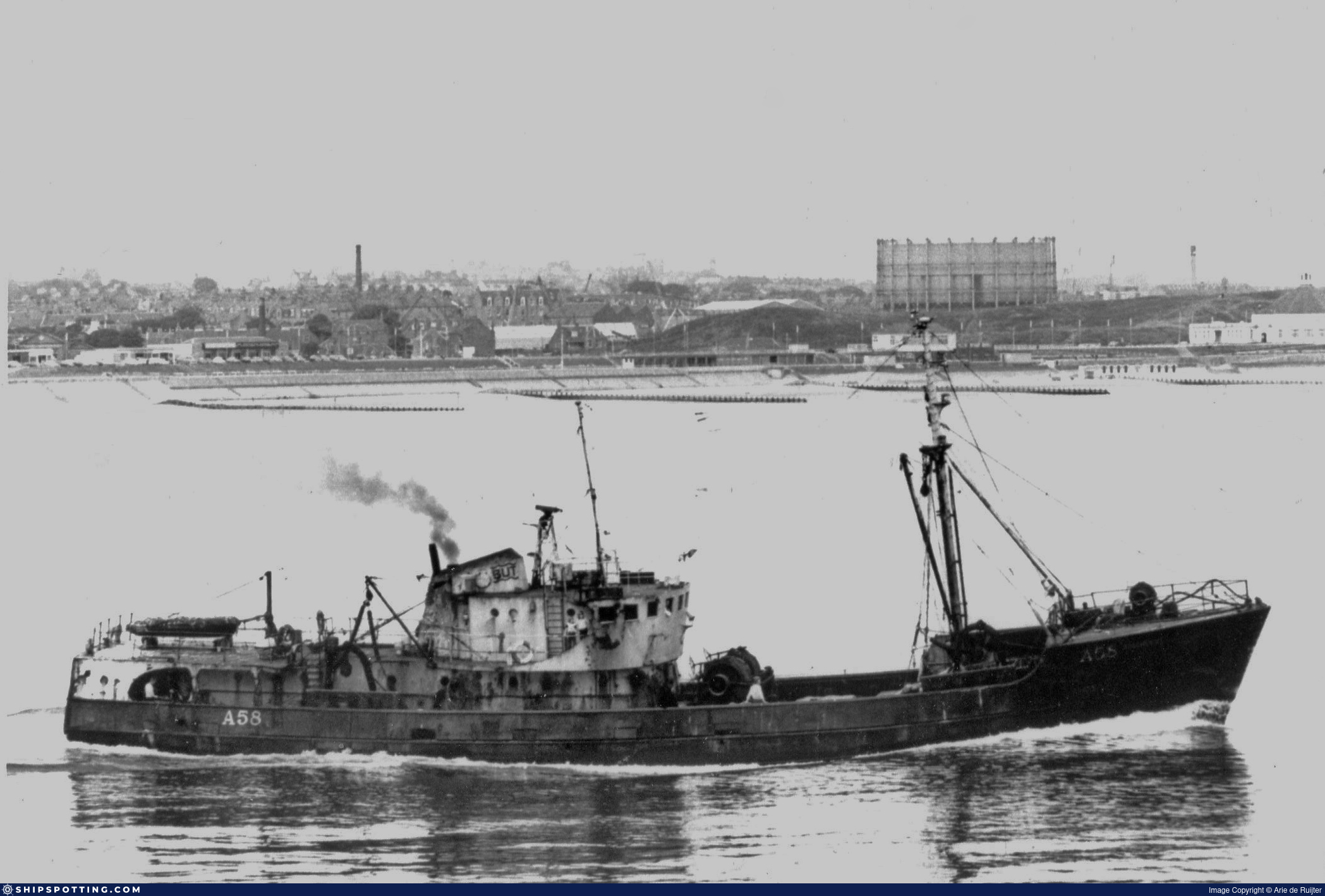 |
| The Birchlea © Arie de Ruiter |
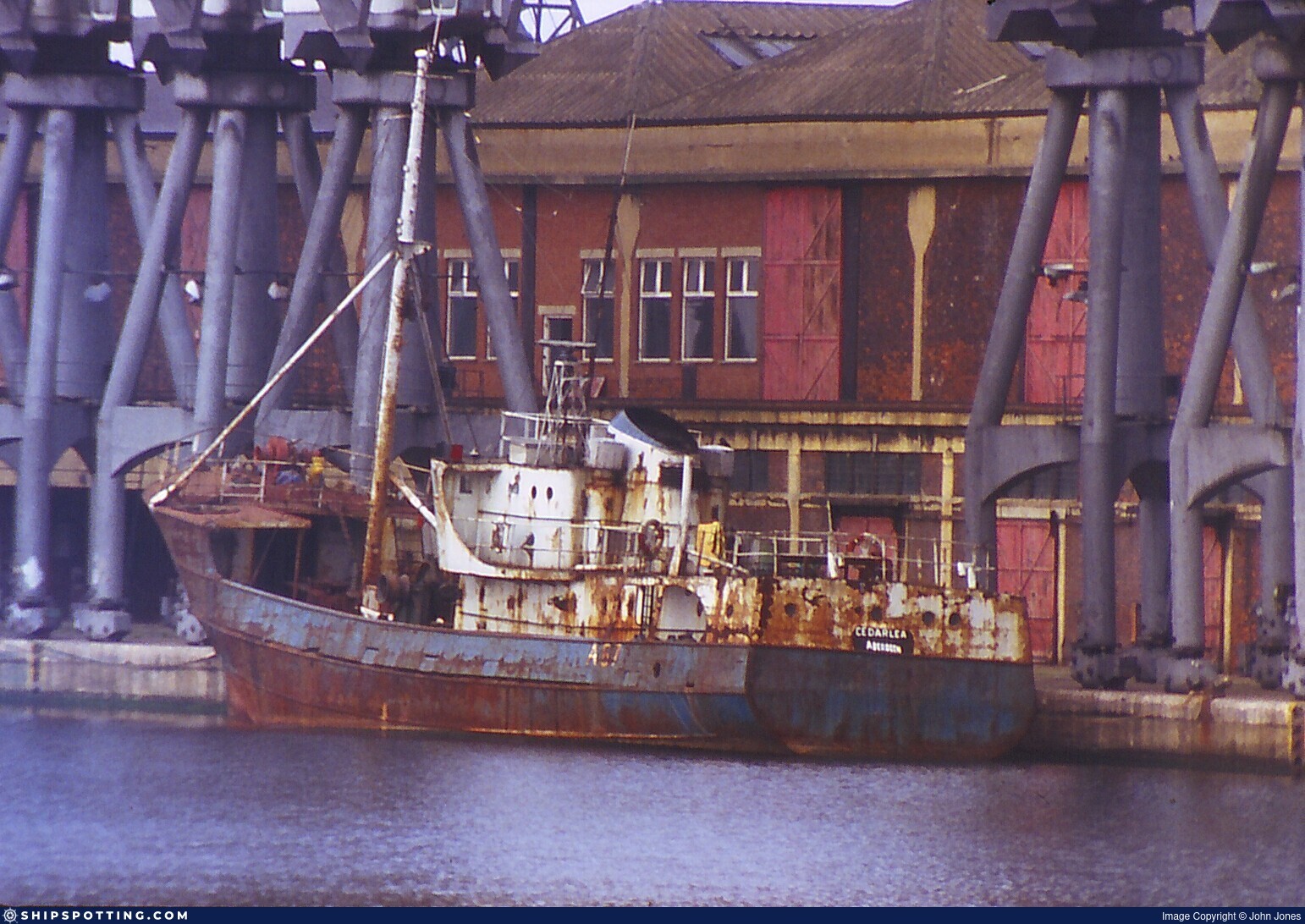 |
| The Cedarlea © John Jones |
The Sister Ships Birchlea and Cedarlea
Atlantic Shipbuilding deep-sea trawlers of 1962
Overview
Cedarlea and Birchlea were near-identical deep-sea side trawlers built in 1962 by Atlantic Shipbuilding Co. Ltd., Newport, Monmouthshire, as consecutive yard numbers 87 and 88. Constructed for Welsh Fisheries Ltd of Milford Haven, they represent the final phase of British post-war trawler construction before the rapid contraction of the deep-sea fishing industry later in the decade.
While their early careers followed closely parallel paths through Milford Haven, Grimsby and Aberdeen, their later histories diverged markedly: Cedarlea gained international significance through service with Greenpeace, whereas Birchlea remained within conventional commercial ownership until disposal.
Technical commonality
Both vessels shared the same basic design and machinery, reflecting Atlantic Shipbuilding’s standardised early-1960s trawler layout:
- Type: Steel deep-sea side trawlers
- Builder: Atlantic Shipbuilding Co. Ltd., Newport
- Year built: 1962
- Gross tonnage: 308 GT
- Net tonnage: 97 NT
- Length: 121–130 ft (depending on measurement standard)
- Beam: 26 ft
- Depth: 12 ft
- Propulsion: Single screw
- Engine: Mirrlees National diesel, 6-cylinder, 4-stroke
- Power: 875 bhp
- Service speed: 13 knots
- Crew: about 12
Welsh Fisheries: Milford Haven origins (1962–1967)
- Cedarlea entered service as Welsh Monarch (M135)
- Birchlea entered service as Welsh Consort (M140)
Both ships were registered at Milford Haven in late 1962 and operated from the port as part of the Welsh Fisheries fleet. They worked as North Atlantic deep-sea trawlers during the last period when Milford Haven still maintained a significant distant-water fishing presence.
Ross Trawlers: Grimsby period (1967–1968)
In 1967, both vessels transferred into the Ross Trawlers group at Grimsby, reflecting the consolidation of the British trawler industry:
- Welsh Monarch → Ross Beaver (GY 1387) (later Cedarlea)
- Welsh Consort → Ross Badger (GY 1386) (later Birchlea)
Both ships were managed under John Malcolm Ross and operated from the Fish Docks at Grimsby, continuing conventional commercial fishing operations.
British United Trawlers: Aberdeen service (1968–1980)
By 1968, both vessels had moved north to Aberdeen under British United Trawlers (Aberdeen) Ltd:
- Ross Beaver → Cedarlea (A67)
- Ross Badger → Birchlea (A58)
Ownership later passed to Craig’s Stores (Aberdeen) Ltd, part of the same corporate group. Throughout the 1970s, Cedarlea and Birchlea worked from Aberdeen as part of the city’s declining but still active deep-sea trawler fleet.
Diverging paths after 1980
Cedarlea
- 1980: Ceased fishing and laid up
- Early 1980s: Briefly considered as a vessel for the palnned offshore radio station Radio Phoenix
- 1982–1985: Chartered by Greenpeace, renamed Greenpeace, and employed as a biological research and environmental campaign vessel
- 1982: Participated with Sirius in actions against large-scale nuclear waste dumping off north-west Spain
- 1985: Converted to an offshore standby/safety vessel and renamed Grampian Forest
- 1991: Withdrawn from service
- Post-2000: Believed scrapped
Birchlea
- 1980s: Continued within commercial ownership
- 1982: Registered to Metafarm Ltd (H531)
- Later years: No major conversions recorded
- Final fate: Scrapped (date and location unrecorded)
Historical significance
Taken together, Cedarlea and Birchlea illustrate two contrasting outcomes for vessels of the same class:
- Birchlea represents the typical lifecycle of a British deep-sea trawler, from construction through consolidation and eventual disposal.
- Cedarlea, by contrast, demonstrates adaptive reuse, moving beyond fishing into environmental activism and offshore support work, thereby acquiring a broader historical profile.
As sister ships built side by side, their shared origins and diverging later careers provide a valuable case study in the economic, social and political changes affecting British maritime industries from the 1960s to the 1990s.