
Shortwave Broadcasts from Warships in the Global War on Terror
 In the early years of the twenty-first century, shortwave radio—long considered a declining medium—regained strategic importance in the context of the Iraq War in early 2003. This was also evident in 2004 and 2005 during the so-called “Global War on Terror.” One of the more unusual and historically significant examples of this revival was the establishment of Coalition Maritime Forces Radio One (CMF Radio One), a low-power shortwave broadcasting service operated by the United States Navy through its Maritime Liaison Office (MARLO), headquartered in Bahrain. Beginning in April 2004, this operation combined elements of psychological operations, maritime security communications, and traditional radio broadcasting, targeting mariners across the Persian Gulf, Gulf of Oman, Arabian Sea, and beyond.
Origins and Official Disclosure (April 2004)
The existence of the broadcasts first came to public attention through a navigational warning rather than a conventional media announcement. On 20 April 2004, the U.S. National Geospatial-Intelligence Agency (NGA) published HYDROPAC 694/2004 as part of its Daily Memorandum, Pacific Edition. The warning, intended for mariners operating in the Persian Gulf, explicitly announced the commencement of “Coalition Maritime Broadcasts” on shortwave high-frequency (HF) radio as of 15 April 2004.
According to the official text, the broadcasts were initiated “in response to all mariners that have helped Coalition Maritime Forces in the Global War on Terror” and as a means to build broader engagement with regional audiences. Programming consisted primarily of popular regional and international music, interspersed with informational segments in Arabic, Farsi (Persian), Hindi, Pashto, Urdu, and English. These announcements provided instructions on how listeners could assist coalition forces by identifying and reporting terrorist activity at sea.
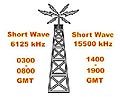 Two daily transmission windows were specified: a morning broadcast from 0300 to 0800 UTC on 6125 kHz, and an evening broadcast from 1400 to 1900 UTC on 15500 kHz. Although the original web page hosting the warning was frequently updated and later removed, cached versions preserved by search engines and promptly noted by DX enthusiasts confirmed the authenticity of the announcement.
MARLO and the Strategic Context
The broadcasts were coordinated by the Maritime Liaison Office (MARLO), an organization established to facilitate information exchange between the United States Navy and the commercial shipping community within the U.S. Central Command (CENTCOM) area of responsibility. MARLO’s stated mission emphasized maritime safety, situational awareness, and cooperation with civilian mariners—an especially critical concern in the post-9/11 security environment, where fears of maritime terrorism, attacks on oil terminals, and the use of shipping lanes by non-state actors were prominent.
Radio Netherlands and later BBC Monitoring independently confirmed MARLO’s role, noting that the broadcasts were part of a broader effort to encourage voluntary intelligence sharing from seafarers. The informational segments also promoted the U.S. “Rewards for Justice” program, which offered financial incentives for information preventing or resolving terrorist acts.
Technical Characteristics and Early Monitoring
From the outset, the broadcasts proved difficult to monitor for the international DX (radio listening) community. This was largely due to their technical configuration: transmissions originated from coalition naval vessels operating in the Gulf of Oman and the northern Arabian Sea, using transmitters with a power output of approximately 250 watts. Such low power, combined with HF propagation characteristics and skip zones, meant reception was sporadic and geographically uneven.
Nevertheless, by early May 2004, confirmed receptions began to emerge from Europe. On 4 May 2004, Finnish DXer Jari Savolainen reported hearing an upper sideband (USB) transmission on 15500 kHz featuring continuous Middle Eastern and South Asian music, with intermittent announcements in Urdu or Hindi and English, including a U.S. toll-free telephone number associated with the Rewards for Justice program. These observations strongly suggested that the broadcasts were not merely informational but constituted a form of psychological operations (PSYOP), echoing similar naval broadcasting activities conducted during the Iraq War.
Expansion, Rebranding, and Frequency Changes (2004–2005)
By late 2004 and into 2005, the service increasingly identified itself as “Coalition Maritime Forces Radio One,” sometimes shortened to “CMF Radio One” or simply “Radio One,” and occasionally as “Information Radio” which is in Arabic „Radiyo al-Ma’ulumat.“ Programming remained music-heavy—approximately 90 percent—reflecting an intentional strategy to attract and retain listeners, with brief multilingual announcements embedded at intervals.
In 2005, a significant operational change occurred with the introduction of a new frequency: 9133 kHz (USB). This frequency offered improved reception in Europe and the eastern Mediterranean, as confirmed by numerous DX reports from Sweden, Austria, and Finland. BBC Monitoring formally documented broadcasts on 9133 kHz on 1 May 2005, noting Afghan and Arabic music interspersed with appeals for information related to terrorist activities, including specific references to Iraqi oil terminals.
During this period, MARLO officials acknowledged negotiations to transfer the broadcasts to Merlin Communications facilities in the United Arab Emirates or the United Kingdom. Such a move would have substantially increased transmitter power and coverage, though no final agreement was confirmed at the time.
Interaction with the DX Community and QSL Confirmations
Unusually for a military-linked broadcaster, CMF Radio One demonstrated a degree of openness toward the DX community. In April 2005, Chief Warrant Officer Matthew Wilson of the U.S. Navy contacted listeners directly, thanking them for reception reports and soliciting further feedback on signal quality. This correspondence confirmed active use of 6125 kHz and 9133 kHz, with plans to return to 15500 kHz.
Several DXers received official QSL confirmations, including written replies from U.S. Naval Forces Central Command and the U.S. Fifth Fleet. These confirmations, often signed by senior officers, conclusively established CMF Radio One as an official U.S. Navy operation rather than an ad hoc or clandestine broadcaster.
Historical Significance
Coalition Maritime Forces Radio One represents a rare modern example of ship-based shortwave broadcasting used for strategic communication rather than entertainment or public diplomacy alone. It stands at the intersection of naval operations, intelligence gathering, psychological operations, and the long tradition of maritime (offshore) radio. While modest in technical scale, its existence underscores how legacy technologies such as shortwave radio continued to play a role in twenty-first-century security operations—particularly in environments where internet and satellite communications could not be assumed.
For radio historians and DXers alike, CMF Radio One occupies a distinctive place: a low-power, multilingual, officially acknowledged military broadcaster operating from international waters, whose presence was first revealed not through press releases, but through navigational warnings and the careful listening of the global shortwave monitoring community.
Martin van der Ven, January 2026
Audio recording
Sources:
https://www.dxing.info/news/2004_04.dx
http://www.worldofradio.com/dxldmid4.html
http://www.worldofradio.com/dxldmid5.html