Jeff: Radio Caroline, which started test broadcasts from International Waters on Good Friday in March 1964, is often credited with being the first British offshore radio station. However, few people realize there was actually another English language station in the North Sea several years before that, in late 1960 and early 1961. Here’s Ray Robinson in Los Angeles with the story.
Ray: Thanks, Jeff.
Following the success of Radio Mercur, broadcasting off the Danish coast since 1958, Radio Veronica had been launched off the Dutch coast near The Hague in April 1960, using a former German lightship called the Borkum Riff. The ship only had a 1 kW transmitter, and they experimented with it on several frequencies just above the top end of the medium wave band, before eventually settling on 1562 kHz, 192 meters. They used a center-fed wire antenna strung between the fore and aft masts of the ship.
foto Noord-Hollands Archief, collectie Fotopersbureau De Boer. Ingekleurd door Harm Koenders.
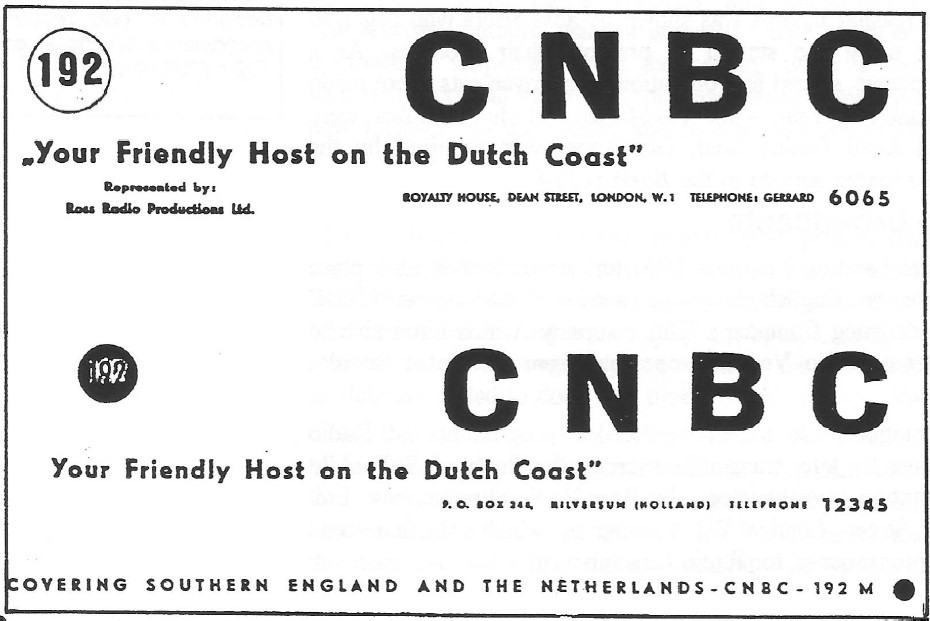
Although Veronica was quickly a hit with listeners in The Netherlands, it wasn’t an immediate financial success. So, in an effort to attract a larger audience and more advertising, they decided to start late night English language programmes under the name CNBC, which stood for the Commercial Neutral Broadcasting Company. These programs, which were targeting East and South East England, began on Wednesday, November 23rd, 1960. They were run by a Canadian DJ, Doug Stanley, who had previously worked for the British Forces Network in Cologne, Germany. As with Veronica’s Dutch service, all the programmes were pre-recorded in a studio on land, initially in The Hague, and later in Hilversum. They were then taken out to the ship on tape. Here are a couple of clips from that very first test broadcast.
< Audio Clip – 1960 11 23 Wed – CNBC – Doug Stanley – first test >
Most of the music played in the early tests was swing, big band and jazz, but they did eventually move to a middle-of-the-road format, with show tunes and other light music, packaged in 15 or 30 minute program segments. Two strap lines were used:
“The Radio Sound of Tomorrow Today” and
“Your Friendly Host on the Dutch Coast”,
but the station never got as far as commissioning a jingle package to be produced.
CNBC’s offices were at Royalty House, Dean Street, London, and advertising sales were handled by Ross Radio Productions Ltd., 23 Upper Wimpole Street, London W1, which at the time also produced sponsored programming for Radio Luxembourg.
Quite a lot of press publicity was given in England to the launch of the new station, and questions were even asked in the House of Commons about CNBC’s broadcasts directed at Britain. The Lord Privy Seal (and later, Prime Minister) Edward Heath, was asked whether representations had been made to the Guatemalan Government over the registration of the radio ship, Borkum Riff, in apparent contravention of the 1958 Convention of the High Seas. Mr. Heath said the Guatemalan Government had assured British authorities that the vessel was not registered with them, and he informed the House that it was not clear which was the country of registration of the vessel.
The BBC, meanwhile, monitored the offshore station’s broadcasts and a spokesman said: “We shall watch developments with interest and we shall certainly take action if it interferes with BBC broadcasts.” The spokesman did not specify what action would or could be taken, but the nearest frequency used by the BBC at that time was for some low power transmitters on 1484 kHz, 202 metres, 9 channels away from Veronica/CNBC, and no interference was ever observed or reported.
In 1960, Radio Veronica’s Dutch programming used to close down in the early evenings, and the initial tests of CNBC programs were transmitted late at night, from midnight to 3am. Unfortunately the coverage area achieved by these tests was not what was hoped for, and during those hours, listenership was very small. Transmissions couldn’t begin any earlier in the evenings, because of a 120,000 watt transmitter in Switzerland that was also on 1562 kHz, the sky wave of which blanketed the frequency across Europe after dark. So, CNBC had to wait for the Swiss station to close down before they could begin broadcasting.
On 16th February 1961, CNBC decided to try a different tack, and ran more tests for a couple of hours from 5am, before Radio Veronica opened its programming for the day. And then a few days later, CNBC English language programming began to be heard from 8am-1pm daily. The presenters by that time included Doug Stanley, fellow Canadian John Michael, Bob Fletcher and Paul Hollingdale, who like Doug had previously been with the British Forces Network in Germany. These were professional broadcasters who were able to give invaluable technical advice to Veronica’s Dutch staff. Sometimes Radio Veronica’s Dutch DJ’s would be pressed into doing double duty on CNBC as well, such as you can hear in this clip of Tony Vos in February 1961.
< Audio Clip – Tony Vos >
The regular program schedule became 6am-12 noon and 11pm-2am, with a two hour later start in the mornings at weekends.
An attempt was made to buy a higher power transmitter from Telefunken in Germany, but the BBC, an important customer of Telefunken, applied pressure for them not to make a sale to the Veronica organization. And although the station’s owners, the Verwey brothers, had then assured Doug Stanley that a 5 kW transmitter would be purchased from RCA in the United States, that didn’t happen either as the station engineer absconded with the funds to buy it.
Because of Radio Veronica’s low power transmitter, reception of the CNBC signal in England was weak, and was mainly confined to areas along the east and south east coasts. The important commercial target area of London could not be reached. Because of this and the steadily increasing popularity of Radio Veronica’s Dutch language programs in The Netherlands, CNBC broadcasts were discontinued on March 22nd, 1961. The few hours a day allocated to the English language station could then be more profitably filled by Radio Veronica’s Dutch programming and advertising. Both Doug Stanley and Paul Hollingdale went on to work for Radio Luxembourg together, after which Doug moved to Adelaide, Australia and Paul went on to a long career in British broadcasting on various BBC and local radio stations.
The promised increase in output power for Veronica never did occur until August 1966 when the Borkum Riff was replaced by the MV Norderney, an ex-trawler, with a new 10 kW transmitter. So, although CNBC was rather short-lived as a radio station, it did have the distinction of being the first offshore radio station whose programs were directed at a British audience. The low power of the transmitter on the Borkum Riff and its distance from the English coast hampered CNBC’s chance of success, but the potential of this English language offshore station had not gone unnoticed. Before long, plans were being made by a number of British businessmen to set up offshore stations with sufficient transmitter power and on structures, or ships anchored, in positions which would ensure a strong signal did reach the commercially important areas of London, south east England and the Midlands.
Back to you, Jeff.
From: Wavescan N825, December 15, 2024
Wavescan is an international DX program, researched and written in Indianapolis by Dr. Adrian Peterson and in Los Angeles by Ray Robinson. Wavescan is produced in the studios of WMRI Shortwave in Okeechobee, Florida, by Jeff White.
The program frequently covers radio stations aboard ships. These reports are documented here.