
Music Man 279: The Long Wave Dream That Never Was
At the turn of the millennium, when most observers believed the age of offshore radio had long since passed into history, an ambitious project emerged that seemed to echo the spirit of the great pirate stations of the 1960s. The proposed station Music Man 279 aimed to broadcast on 1075 metres (279 kHz) from the waters off the Isle of Man, reviving long-wave broadcasting and, in the process, bringing two elderly North Sea trawlers into the orbit of radio folklore.
Among them was the rugged MV Grampian Princess, a vessel whose unlikely journey—from fishing trawler to offshore support ship, and ultimately to a proposed floating transmitter base—captures both the optimism and the complications that surrounded the Music Man 279 venture.
The Concept: A Long Wave Superstation

The proposed transmission site was Ramsey Bay, on the northeast coast of the Isle of Man. The long-term plan involved constructing an offshore transmitting platform known as Caroline Island, from which the station would beam its signal across Britain and northern Europe.
Behind the venture stood a consortium of investors and radio professionals, with Paul Rusling playing a central role in the early development of the scheme. Interest in long-wave broadcasting still existed among certain media operators, and the Isle of Man government had initially been supportive of the concept.
However, before the permanent platform could be built, a temporary solution was considered: broadcasting from a ship.
The Vessels: North Sea Workhorses
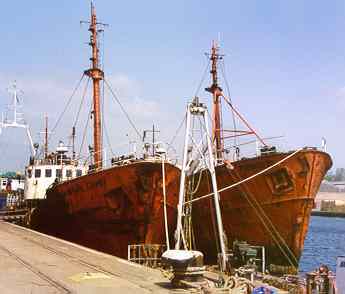
Two former trawlers—Grampian Princess and Grampian Dawn—became unexpectedly associated with the Music Man 279 story. Both vessels had remarkably similar origins.
They were constructed at the John Lewis & Sons shipyard in Aberdeen, a yard known for building robust fishing vessels capable of operating in the harsh conditions of the North Sea.
The Grampian Princess
The MV Grampian Princess, originally launched in 1960 under the name Linden Lea, was a 37-metre all-steel vessel built for North Star Shipping, owned by George Craig & Sons of Aberdeen.
Key specifications included:
- Gross tonnage: 280 GRT
- Net tonnage: 95 NRT
- Length overall: approximately 39 metres (127 ft)
- Beam: 25.65 ft
- Draft (moulded depth): 12.75 ft
- Displacement: 492.5 tonnes
Power came from a Mirrlees “K” type six-cylinder diesel engine, delivering 712 horsepower at 200 RPM and driving a four-blade fixed-pitch propeller.
The vessel also carried substantial auxiliary machinery:
- Winch engine: Mirrlees TLA five-cylinder (262 hp)
- Generators:
- Two Gardner 3LW units producing 20 kW DC each
- One Gardner 6LW unit producing 25 kW DC
- Main generator output: 143 kW
With a range of over 40 days at sea and an average cruising speed of 10–12 knots, the vessel was well suited to offshore operations. Accommodation was provided for 15 crew members, and a two-ton crane and spacious hold made the ship adaptable for a variety of industrial roles, including diving support work.
From Fishing to Oilfields
Like many North Sea trawlers of her generation, the vessel’s working life evolved as the fishing industry changed.
During the 1980s, the ship was converted from a fishing trawler into a standby rescue and safety vessel serving the rapidly expanding offshore oil industry. In this role she functioned as a rig support and pollution-control ship, standing by near drilling platforms to provide emergency assistance.
Her sister vessel Grampian Dawn—formerly Ben Strome, built in 1962—underwent a similar transformation. Slightly different in tonnage but comparable in size and power, she also operated as a standby safety vessel after her fishing career ended.
A Long Period of Neglect
By the early 1990s both vessels had fallen out of active service. Changes in maritime safety legislation and the evolving requirements of the offshore oil industry rendered them obsolete.
According to information compiled by maritime researcher Bob Le-Roi, the ships eventually lay idle in Aberdeen before being moved south.
In 1991, the two trawlers were brought to the River Thames, where they were moored at a shipyard on the Kent side of the river opposite Tilbury Dock. There they remained for more than a decade, slowly deteriorating while awaiting an uncertain future.
Neither vessel had operated under its own power for many years. Despite their robust Mirrlees engines, both ships had effectively become non-operational hulks.
A Surprise Purchase
In the early 2000s the dormant trawlers unexpectedly re-entered the story of offshore radio.
Entrepreneur Paul Graham reportedly inspected the ships and arranged their purchase for a modest sum—around £10,000—with financial backing from Ray Anderson.
The plan was unusual but straightforward:
- One vessel would be sold to recover the purchase cost.
- The other would be converted into a mobile broadcasting platform for the Music Man 279 project.
Because the engines were no longer operational, the vessels had to be towed from London to Ipswich Docks. During the journey one reportedly suffered minor damage after a collision with the tug.
The shipyard handling the move also transferred a large quantity of spare parts along with the vessels. At the time it was believed that these components might be resold to generate funds. Later assessments suggested the parts had little commercial value and might even represent a disposal problem due to hazardous materials.
Reality Sets In
Despite the optimism surrounding the purchase, the technical condition of the vessels soon became apparent.
After more than eleven years of neglect, virtually none of the machinery was operational. Engines, electrical systems and onboard equipment all required extensive refurbishment.
One observer reportedly saw financier Ray Anderson sitting on the deck of one of the ships with “his head in his hands”—a vivid image that captured the scale of the challenge now facing the project.
At the time, plans were discussed to dry-dock one vessel for shot-blasting while efforts continued to find a buyer for the other. It was also speculated that Ray hoped to use the proceeds from the second ship to convert the remaining ship into a floating RSL station.
Legal Problems on the Isle of Man
Even as work on the ships stalled, the core Music Man 279 project faced legal difficulties.
In August 2002, the venture suffered a significant setback when a request for a judicial review reached the High Court. The action had been brought by the Bride Commissioners, a local parish authority on the Isle of Man.
They objected to the government’s decision to allow construction of the offshore Caroline Island transmission platform. The petition sought to compel the Isle of Man Department of Transport to reconsider the approval and to hold a public inquiry.
Because the case had not yet been resolved, construction of the transmitter site had to be suspended.
Paul Rusling described the situation at the time as both astonishing and deeply frustrating, noting that the project had already endured numerous delays.
The Ships Go Up for Sale
By late 2002, the two former trawlers were themselves placed on the market in Ipswich, with an asking price of around £75,000 each.
The once-ambitious idea of converting one of them into a floating transmitter platform was quietly fading.
In February 2003, the Grampian Princess even appeared for sale on eBay, where the vessel—complete with her Mirrlees engine and offshore equipment—was advertised for approximately £20,000.
Searching for Alternatives
With the Caroline Island project tied up in legal disputes, alternative broadcasting solutions were briefly considered.
One possibility involved using the MV Communicator, a vessel associated with another offshore radio venture operating near Orkney. At the time, that project was facing financial difficulties, raising the prospect that the ship might become available as a temporary base for Music Man 279.
However, the plan never advanced beyond discussion.
The Long Wait
By 2006, the project had already acquired a reputation for delays. Local newspapers on the Isle of Man began referring to it wryly as the “Long Wait Radio Station.”
Further problems emerged when the company behind the project attempted to recover a £300,000 deposit from Kabbary Antenna Technology, following the non-delivery of a specialised cross-field antenna intended for the station’s transmission system.
The technical and financial hurdles continued to accumulate.
Internal Disputes and the End
In January 2007, internal disagreements among shareholders reached a breaking point.
Paul Rusling and several of the radio professionals involved in the project withdrew their participation as confidence in the station’s commercial viability declined.
By October 2007, the project’s websites had disappeared from the internet, signalling what many observers had already suspected: Music Man 279 would never go on the air.
A Footnote in Offshore Radio History
Although the station never launched, the Music Man 279 story remains a fascinating footnote in the long history of offshore broadcasting.
It illustrates the enduring allure of powerful radio signals transmitted from the sea—an idea that began with stations such as Radio Caroline in the 1960s and continues to capture the imagination of radio enthusiasts decades later.
For the Grampian Princess, the episode represents yet another chapter in a working life that already spanned fishing grounds, North Sea oil platforms and shipyards.
Whether she ever came close to becoming a floating radio station is debatable. Yet for a brief moment, this sturdy Aberdeen-built trawler was part of a dream to bring long-wave offshore broadcasting back to life.