Jeff: Over the last two weeks, Ray Robinson has covered the radio broadcasting history of Ireland on both medium wave and shortwave. Today he looks at the longwave story, which began in the mid-1980’s. Here’s Ray.
Ray: Thanks, Jeff. For those who were of Irish extraction living in Great Britain during the early 1980’s, it was very difficult to stay in touch with home. Many felt cut off from family and friends in Dublin. Flights were expensive (three weeks wages for a one-way flight to Dublin), phone-calls intermittent, and taking the train and ferry home was an expedition. There was no internet, no Facebook or other apps for staying in touch, and no Irish news sources other than print.
Even those who lived in one of the Irish areas of London, and had the luxury of newsstands which sold newspapers from home, those would always be yesterday’s papers. But if they tuned down to the low end of the medium waveband they might be able to find RTE from Tullamore with 500 kW on 567 kHz. Not really clear enough to hear well during the daytime, but it came in better at night, especially in winter. Those in the north or west of England would hear RTE more clearly.
As we know, medium wave broadcasts can carry a lot further than FM if enough power is used, but long wave goes further still, so it’s odd that RTE didn’t use longwave in those days, despite Ireland having been allocated a longwave frequency at the Geneva conference in 1975. It was only when pirate Chris Cary made some test transmissions on long wave in the mid-1980’s that RTE sat up and took notice.
Cary was the owner of Radio Nova – arguably the most professional and most successful of all the unlicensed Irish radio stations in the 1980’s. The station operated on 88.5 MHz FM and 819 kHz AM from Dublin, with a full 50 kW on the medium wave frequency. Many listeners in the Northwest of England were tuning in and there was some interest from advertisers too. Indeed, UK radio stations were really feeling the heat from Irish-associated interlopers in the mid-1980’s, because as well as Radio Nova coming in strongly from across the Irish sea, two powerful medium wave pirates – Caroline and Laser 558 – were beaming in from the North Sea and scooping up listeners in the heavily populated London & South East region.
Radio Caroline, founded and still operated at the time by the great Irish eccentric Ronan O’Rahilly, offered a mellow mix of rock, pop and album tracks and was moderately successful.
But high energy Laser 558, with an all-American crew, targeted young audiences with a very focused “hot hits” format, was estimated to have acquired up to 9 million listeners within a few months of launching. And although the voices on air were American, the station was bankrolled by well-known Dublin businessman Philip Smyth.
In Ireland, they may have been big viewers of British television, but the British sure did like listening to Irish radio – whether they knew it or not.
Chris Cary wanted to expand Radio Nova’s reach into the UK still further, and figured that the longwave could help him. Tests were conducted in December 1985 and January 1986 on 254 kHz carrying a relay of Radio Nova’s medium wave signal. These longwave tests were first reported on Radio Netherlands’ Media Network program on Thursday, December 12th, 1985, and then Media Network again reported on January 23rd, 1986 that the signal strength had been increased, although it was still only around 15 kW. However, the station never launched full time on longwave, and in fact closed down completely just six weeks later.
Seven months after Cary’s tests, in August 1986, the Irish state broadcaster, RTE, announced that they were planning a joint venture with RTL, the owners of Radio Luxembourg, to launch a new pop music service on the same frequency. Their intention was not just to cover Ireland, but to beam the service into the UK on high power, collecting as many listeners and advertisers as they could.
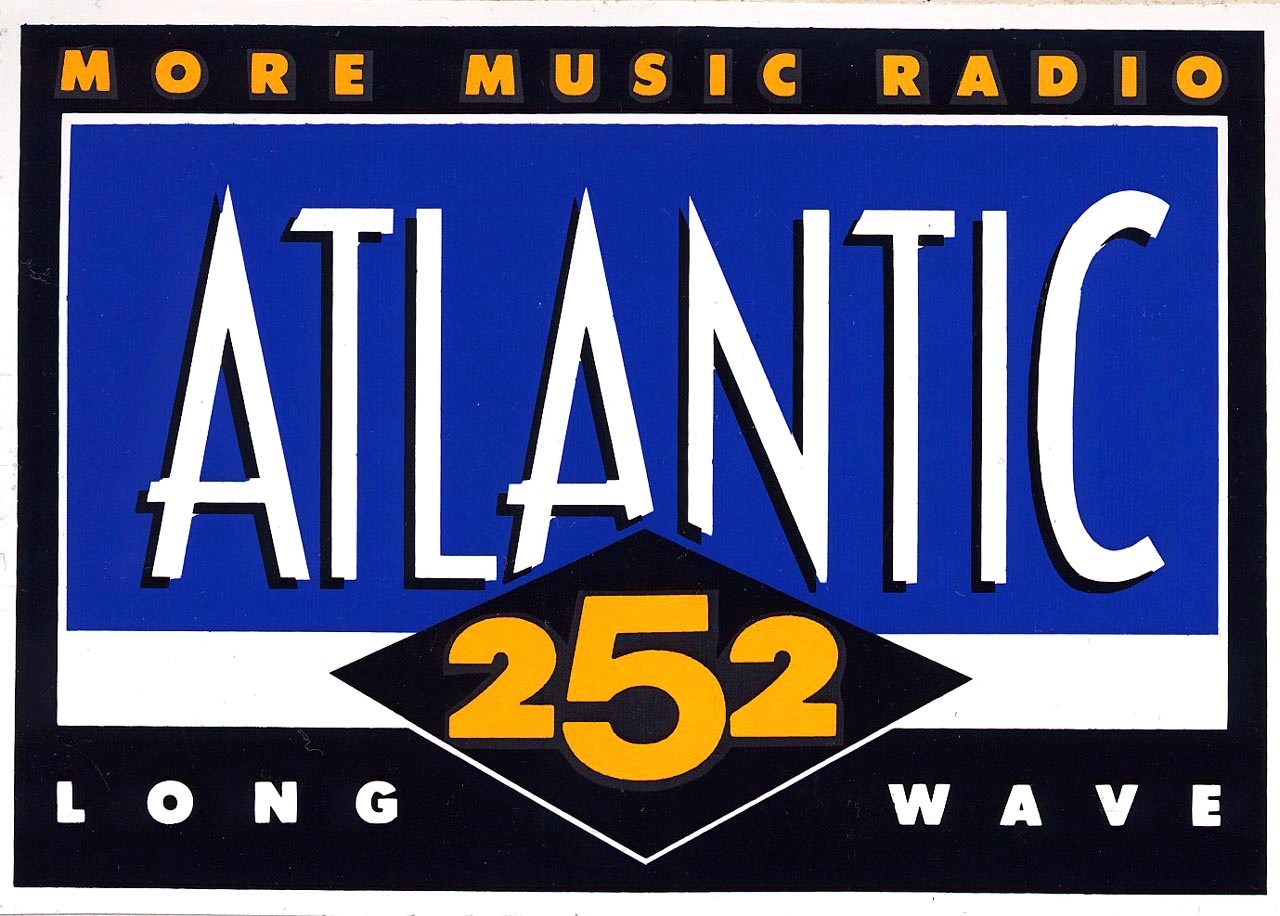
The project was originally christened Radio Tara (after the ancient capital of Ireland), but following international frequency changes, by the time of the launch, it had been renamed Atlantic 252, broadcasting on 252 kHz, 1190 metres longwave. Although the station had two 300 kW Continental transmitters which were theoretically capable of being combined to operate at a radiated power of 600 kW, international agreements limited it to a daytime maximum 500 kW, and just 100 kW during the hours of darkness.
Locals near the transmitter mast initially complained of interference to phone lines.
Construction of an 813 foot three-sided tower at Clarkestown near Summerhill in County Meath had been controversial, but it went ahead in the face of complaints and protests by locals, and was complete by 1989.
About six miles from the transmitter site, the studios were in a large Victorian house in the town of Trim, a small market town of about 5,000 people situated at a ford on the River Boyne some 25 miles northwest of Dublin. The station duly launched at 8AM on Friday, September 1st, 1989, and the first voice on air was that of Gary King. The first record he played was ‘Sowing the Seeds of Love’ by Tears for Fears.
Official launch:
Initially the station only operated from 6am to 7pm, and at the nighttime closedown, listeners were invited to retune to its sister station, Radio Luxembourg, which also cross-promoted Atlantic 252.
< Audio Clip – Atlantic 252 Promo >
Like the successful offshore pirate Laser 558 (from whom it had nabbed a couple of on-air presenters), Atlantic had a very tightly formatted hit music playlist, and it quickly picked up a large audience. In August 1990, the station extended its broadcasting hours to 2AM, and then in September 1991, it went 24 hours.
Although the transmitter was in Ireland, the signal’s reach meant that it was often looked upon as a “UK national station”. Reception reports were received from such locations as Berlin, Finland, Ibiza and Moscow. The signal had even been received in Brazil at night-time. When Atlantic 252 launched, there were no other UK-wide commercial stations (the first would be Classic FM in 1992), and the lack of a UK broadcast licence attracted the attention of the IBA – the British agency then responsible for regulating all non-BBC broadcasting in the UK.
Even though the majority of UK commercial stations were on FM, with better audio quality, Atlantic 252 proved that if your product was good, you would attract listeners no matter what the medium, as shortwave stations are still proving today.
When the UK launched its RAJAR radio listening figures in late 1992, news outlets reported with surprise that the most listened-to commercial radio station in the UK was a longwave pop service originating from Ireland! It was recorded as having more than 5 million weekly listeners, almost a million ahead of its nearest rival, Classic FM. Amazingly, given the image of longwave as an outdated technology, more than 900,000 of these listeners were in the “under 15” category.
There had been a lot of skepticism of the Irish-based station amongst the media elite in London, and in January 1993, even while reporting the winning listener figures, the (UK) Independent newspaper snippily commented that this was a radio station “broadcast from a field 20 miles from Dublin”. This comment does rather seem to misunderstand how radio stations work – programmes originate from studios, and are sent to transmitters which, requiring large masts, are usually located in fields or on mountaintops.
The same article said that the station could “barely be heard” in the South East of the UK, but there are many who remember driving around Kent and indeed South London with Atlantic 252 blasting out on the car radio. At the peak of its popularity in 1993, Atlantic 252 had six million listeners aged 15+ in the UK and Ireland, but vastly increased competition from deregulated local radio stations with similar formats saw this decline yearly after that.
Atlantic lasted through the 90’s and into the early 2000’s before audiences finally declined, and the station closed at midnight on January 2nd, 2002. By then there were hundreds of new music stations on FM and MP3 players were rising in popularity.
A brief attempt was made to run a sports talk station – TeamTalk 252 – on the frequency, but with stiff competition from BBC Radio 5 Live and talkSPORT in the UK, TeamTalk only lasted about six months. In 2004, RTE finally decided to use the longwave frequency to rebroadcast RTE Radio 1. This had the advantage not only of being able to cover all of Ireland, but also of being able to reach the Irish expatriate community in Great Britain. RTE even conducted some DRM tests on the frequency in 2007, and in 2008, they closed all the MW transmitters of RTE Radio 1, continuing on LW, FM and DAB only.
In the 20-teens, the service seemed to be running on lower power than in the Atlantic 252 days, and the rise of multiple digital services meant that it was no longer the lifeline for the Irish in the UK that it once was.
Considering:
the very large power consumption of the longwave transmitters,
the explosion of RFI on AM frequencies from the myriad of electronic devices in our homes,
the fact that longwave radios are now very rare in new cars, even in Europe,
the comparatively small and ever declining longwave listenership, and
the easy availability of the service through online streaming,
the utility of 252 finally came to an end. The longwave transmitter was switched off for the last time in the early hours of Saturday morning, April 15th, 2023, and the transmitter mast was demolished three months later, on July 27th, 2023.
Mast comes down:
Back to you, Jeff.
From: Wavescan N854. July 6, 2025
Wavescan is an international DX program, researched and written in Indianapolis by Dr. Adrian Peterson and in Los Angeles by Ray Robinson. Wavescan is produced in the studios of WMRI Shortwave in Okeechobee, Florida, by Jeff White.
The program frequently covers radio stations aboard ships. These reports are documented here.

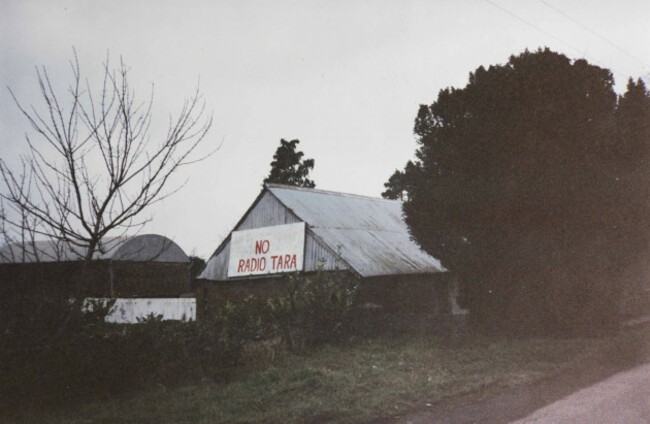
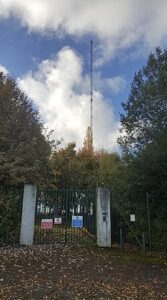 Construction of an 813 foot three-sided tower at Clarkestown near Summerhill in County Meath had been controversial, but it went ahead in the face of complaints and protests by locals, and was complete by 1989.