
Let me take you back to 1970:
Thumb suckers have always been around
It was Thursday, 22 January 1970, when the former Dutch coaster Silvretta, renamed MEBO II, left the port of Slikkerveer for Rotterdam, where it was to be cleared for departure to international waters. The ship was destined to house the newest floating radio station, which would go on the air under the name Radio Nordsea International. An anchorage off the coast of the Netherlands had been chosen by the Swiss owners Erwin Meister and Edwin Bollier. In the weeks leading up to the departure, various newspapers had already revealed some details about the plans, prompting other people – who thought they had a say in the matter – to come forward.
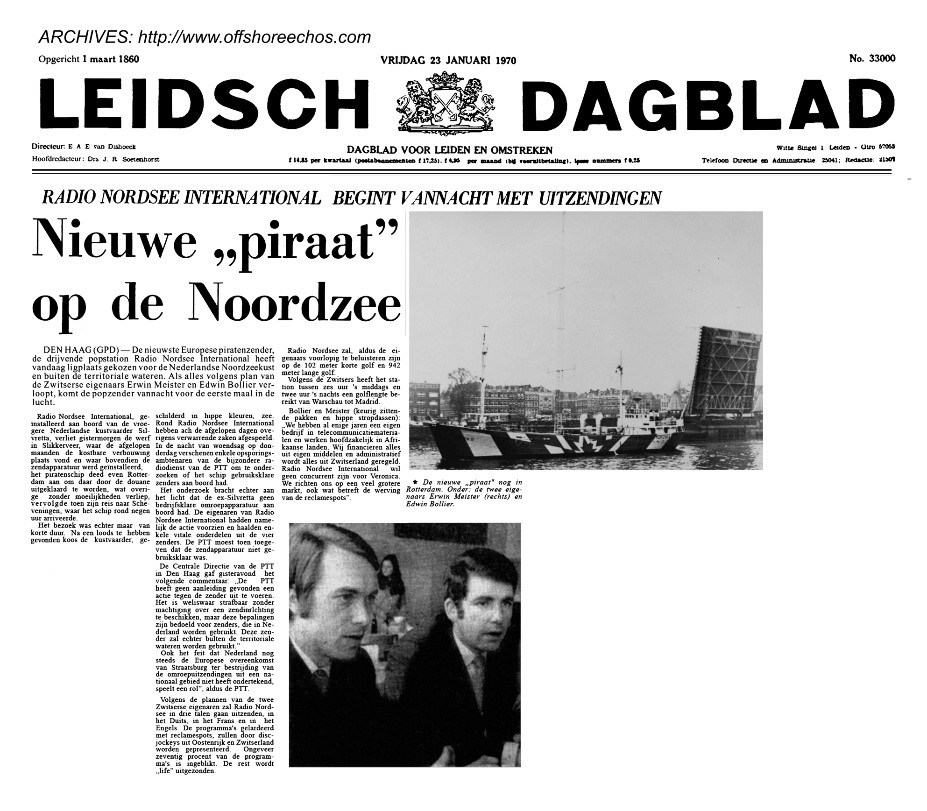
On Friday 23 January 1970, the newspapers reported that, if everything went according to plan for Swiss owners Erwin Meister and Edwin Bollier, RNI would go on air for the first time the following night. The newspapers of the Gemeenschappelijke Persdienst (Joint Press Service) reported: ‘The ship will be located off the Dutch North Sea coast, close to another pirate station, Radio Veronica. RNI will broadcast in German, French and English, initially on 102 metres and 942 metres.
A few days earlier, the owner of a number of chemists in Rotterdam and the surrounding area had indicated that he was financially involved in the new radio project. This man, Jacques Soudan, had previously worked for Radio Dolfijn – another offshore radio station active in parts of 1966 and 1967. On the day of departure, Meister and Bollier spoke at length to the press, where, of course, questions about Jacques Soudan’s involvement were to be expected. It was Erwin Meister and Edwin Bollier who put an end to the fantasy story in a concise and powerful manner.
We have nothing to do with Mr. Soudan. We are the sole owners of the new broadcasting ship MEBO II. Mr. Soudan is a chemist and has no connection whatsoever with our company MEBO Ltd, which is based in Zurich, Switzerland.
Let’s go back to the article in which Jacques Soudan, then 33 years old, made his views known. He said he was commercially involved in the project and also had something to do with the programming. Jacques gave an interview to a morning newspaper, after which journalists (including radio and television) were crowding the pavement outside his chemist’s shop in De la Reystraat in Rotterdam. Quite simply, some journalists took the story as true, noted down the necessary statements in their notebooks and sent the necessary information to their editors as a true story.
But on 23 January 1970, the GPD newspapers published the contradictory, but true, story of the Swiss owners: ‘Bollier and Meister, two friendly Swiss gentlemen, say: “Mr. Soudan came to talk to us to see if he could be hired as a disc jockey for the Dutch programme. We decided not to work with him. He had nothing to do with our project, either commercially or financially.”
Bollier and Meister, wearing smart suits and trendy ties, also state that they have nothing to do with other wealthy Swiss people when it comes to financing this radio project. ‘We have had our own company in various telecommunications materials for several years and work mainly in African countries. We finance everything from our own resources and everything is arranged administratively from Switzerland.’
On the morning before their departure from Slikkerveer, both Swiss men expressed their surprise at Soudan’s story in the canteen of the De Groot en Van Vliet shipyard. Meanwhile, at the Slikkerveer shipyard, the ship was being prepared for the trial run, which was to begin at ten o’clock.
They expressed their hope of mooring their broadcasting ship off Scheveningen in the afternoon. And during the night, they wanted to start the experimental broadcast on the high seas and outside territorial waters. Meanwhile, a journalist from the Joint Press Service had also gathered some words in Rotterdam from Jacques Soudan, who always spoke in the plural about “we”.
“We are going to sea without any programming. Very strange, of course, but it still has to grow. The whole project has been accelerated by the publicity that has been chasing it.” However, Soudan’s story is full of gaps. He is angry with Edwin Bollier and Erwin Meister, but the two Swiss are in turn furious with the Rotterdam chemist. Meister and Bollier provide information about, let’s assume, their ship. They say: “Austrian and Swiss disc jockeys will be on board the ship. The MEBO 2, the broadcasting ship, will be accompanied by the MEBO 1, which will take care of supplies. We can go anywhere. We don’t need to anchor with the broadcasting ship. For the time being, we can be heard on ultra-short wave, at 102 metres, and on short wave at 942 metres (6210 kHz). Between 6 p.m. and 2 a.m., we have a range that extends as far as Warsaw.”
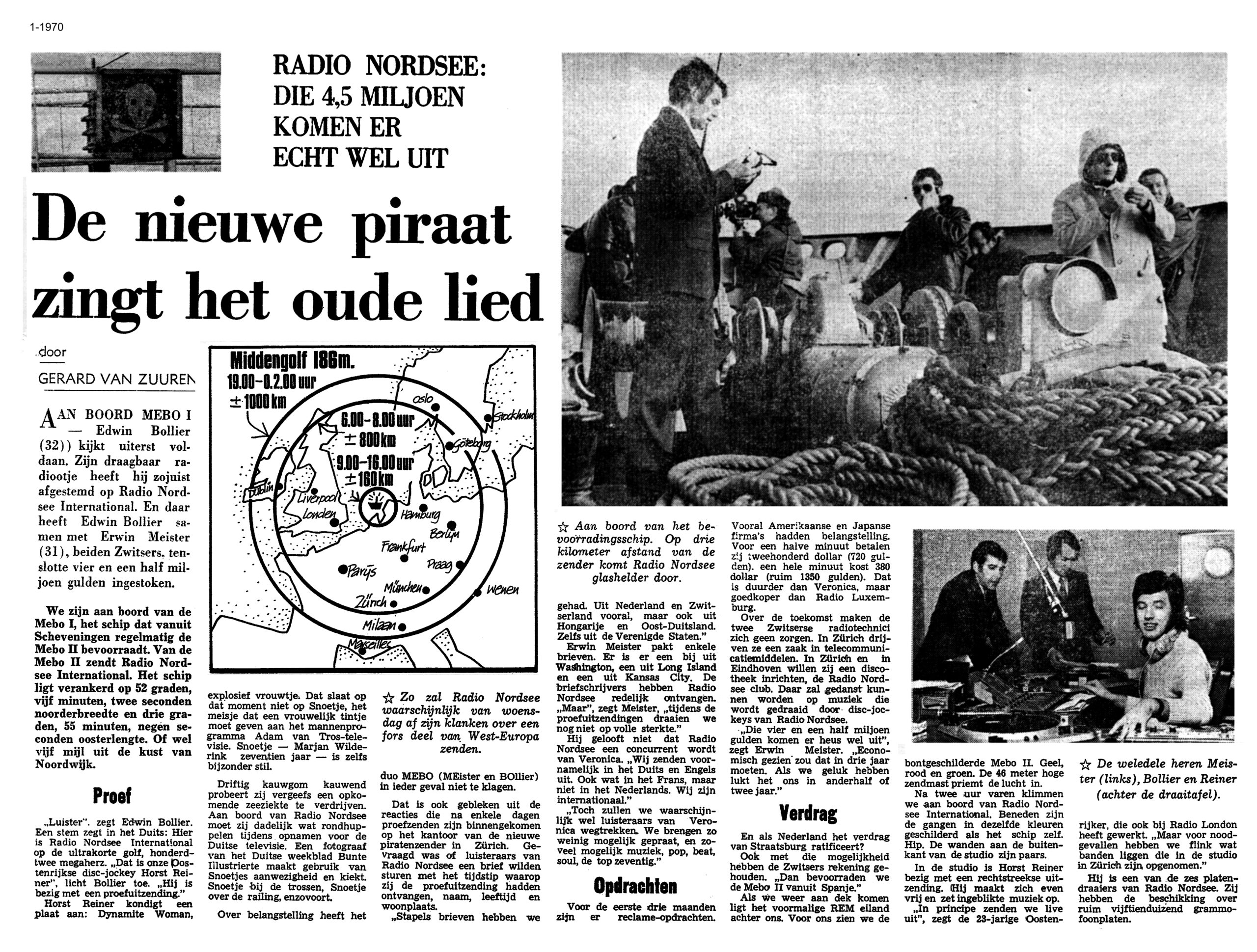
Of course, half of the listening public in the Netherlands was also curious to know whether the Swiss saw their radio station as a competitor to Radio Veronica, which at that time had an absolute monopoly at sea. They indicated that they were targeting a much larger market, also in terms of advertising. And if RNI became a success, they predicted that they would set up a second radio station with commercially oriented broadcasts to Africa. It is noteworthy that when RNI disappeared from the airwaves for the first time for a longer period in September 1970, it was claimed that there was interest in the broadcasting ship from Africa. And speaking of Africa: Jacques Soudan, the thumb sucker, has been living in the southernmost part for years.
Hans Knot January 2026